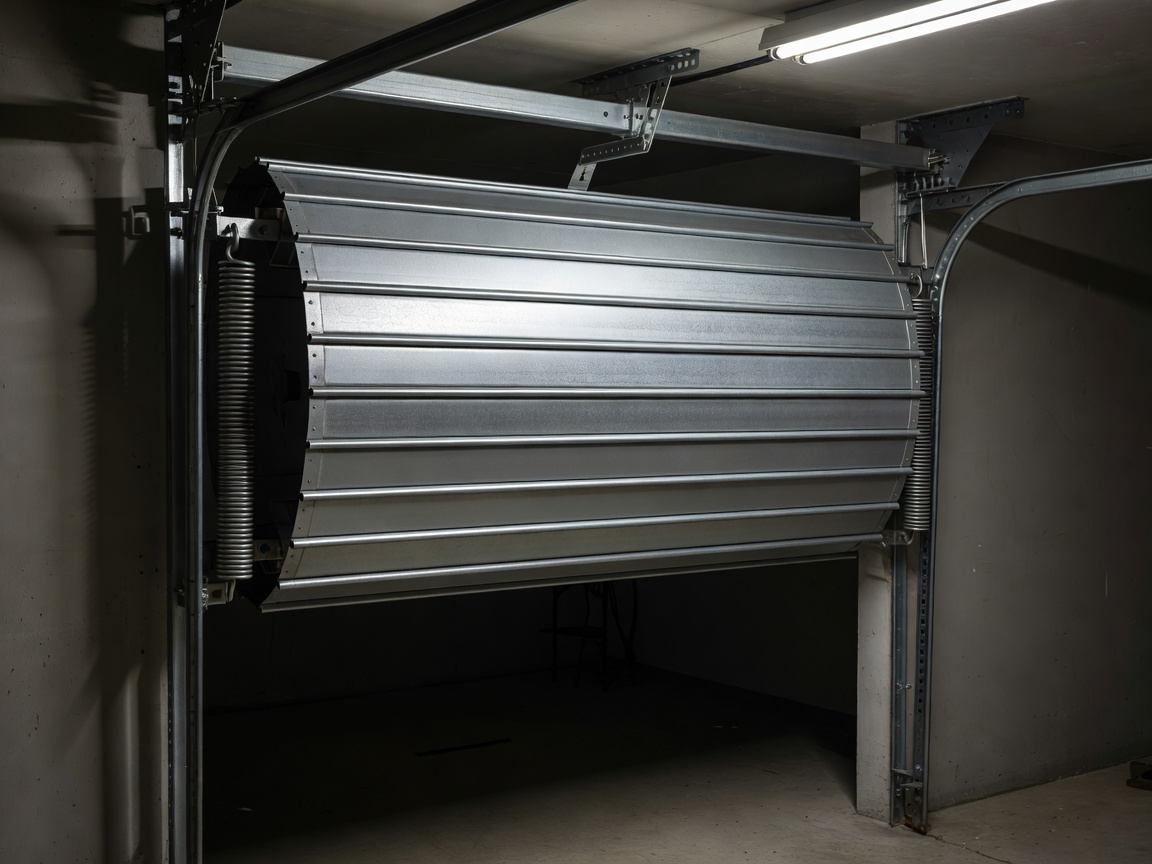
Roller Door Construction and Operation
Roller garage doors are engineered around a fundamentally different mechanical principle compared to panel or swing doors. The ‘door’ itself—referred to as the curtain—is constructed from a series of interconnected, horizontal slats, typically manufactured from twin-walled aluminum or steel. When operated, this flexible curtain travels vertically up side guide-channels and winds tightly around a revolving barrel situated directly above the garage opening.
Because the curtain rolls concentrically upon itself, the entire operating mechanism is contained within a remarkably small footprint near the structural lintel. Like sectional doors, roller doors open entirely vertically, meaning they do not swing out onto the driveway. Vehicles can be parked immediately adjacent to the door face.
Storage Benefits and Space Considerations
The primary advantage of a roller configuration is the preservation of ceiling space. Traditional up-and-over doors and sectional doors require horizontal tracking extending deep into the garage across the ceiling. A roller door eliminates this requirement entirely. This makes them highly suitable for garages in Sheffield where the ceiling space is required for storage racks, suspended lighting, utility meters, or simply where structural beams prevent the installation of deep tracking.
However, the compact nature of the roll necessitates specific structural clearances. A sufficient amount of vertical 'headroom' directly above the structural opening is mandatory to house the fully wound curtain barrel (typically around 300mm, though compact versions require less). If the internal headroom is insufficient, the barrel may need to be mounted slightly lower, partially obscuring the top of the drive-through opening.
Manual and Automated Operation
While lightweight, single-skin steel roller doors are frequently operated manually via a spring-tensioned drum and locking handles, insulated aluminum roller doors are predominantly designed for automated operation. Automated roller systems generally utilize a tubular motor concealed entirely within the curtain barrel itself, further minimizing the visual impact of the installation.
When automated, these systems require a reliable power supply. Consideration must also be given to manual override capabilities. In the event of a power failure, automated roller doors feature a mechanical winding linkage allowing the door to be raised manually. If the garage has no alternative access door, this manual override must be accessible from the exterior via a secure lockable mechanism.
Design Considerations and Installation
Aesthetically, roller doors present a clean, horizontal-lined facade. They are available in a broad spectrum of colors to match property exteriors. Many residential roller doors feature aluminum slats filled with insulating foam, providing a degree of thermal and acoustic insulation, while also offering rigid resistance against wind deflection.
Installation planning involves verifying that the side walls (reveals) are plumb and robust enough to support the vertical guide rails securely. The surface where the bottom edge of the curtain meets the floor must ideally be level to ensure the rubber weather seal compresses evenly, preventing water ingress and drafts.