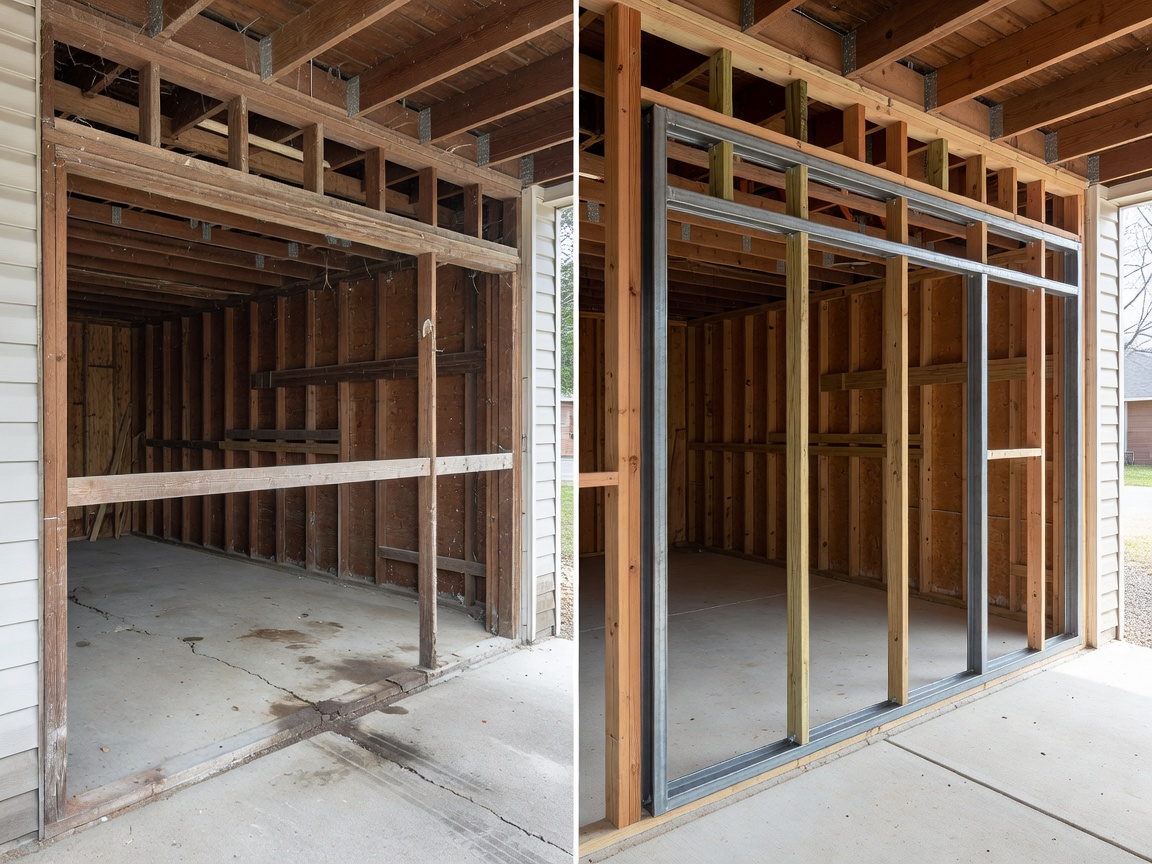
When to Consider Replacement
Garage doors endure significant physical stress over their operational lifespan. Exposure to weather, repetitive mechanical cycles, and accidental impacts gradually degrade both performance and appearance. While routine maintenance can address many minor issues, there comes a point where a complete garage door replacement becomes the more practical, economical, or aesthetically desired solution for residential properties in Sheffield.
It is important to note that not every older garage door requires replacement. If a door remains structurally sound, correctly balanced, and aesthetically acceptable, servicing may suffice. However, replacement is typically considered when structural rot affects timber frames, steel panels are heavily corroded, lifting mechanisms are obsolete or irreparably damaged, or when a property owner wishes to upgrade to an automated, insulated system that the existing door cannot accommodate.
Removing an Existing Door
Replacing a garage door begins with the safe dismantling and removal of the existing system. This phase requires significant care, primarily because older doors are counterbalanced by heavy-duty springs under extreme tension. Attempting to dismantle a door without properly releasing or securing this stored energy is highly dangerous.
The removal process generally involves securing the door panel, safely un-tensioning lifting springs, disconnecting automated operators if present, and subsequently dismantling the tracking hardware and the structural frame (if the frame is also being replaced). Proper disposal of large metal, timber, and composite components is also a necessary logistical consideration.
Measuring and Preparing the Opening
Once the old system is removed, the bare structural opening is exposed. This presents a crucial opportunity to assess the condition of the masonry or structural timber. The brickwork surrounding the opening must be sound, level, and plumb to provide a secure fixing point for the new door mechanism.
Measuring the opening for a replacement involves slightly different considerations than a new build. You are constrained by the existing architecture. If you are replacing a door fitted between the brickwork with a door fitted behind the brickwork (a common approach to increase drive-through width), internal pier space and ceiling clearances must be meticulously re-measured to ensure the new tracking geometry will fit.
Choosing a Replacement Style
A replacement project offers the chance to change the operational style of the door. Common upgrades include:
- Upgrading to Sectional: Moving from an uninsulated single-panel door to an insulated sectional door to improve thermal efficiency, especially if the garage is attached to the house.
- Transitioning to Roller: Swapping bulky overhead tracking for a compact roller mechanism to reclaim ceiling storage space.
- Moving to Side-Hinged: Changing from an overhead door to traditional side-hinged doors if the garage has been converted into a gym, office, or workshop where pedestrian access is prioritized over vehicle parking.
Comparing Operating Mechanisms
When selecting a replacement, compare how different mechanisms will interact with your daily routine. Modern lifting gear—whether torsion spring setups on sectional doors or tubular motors in roller doors—offers smoother, quieter operation compared to aging, stretching extension springs common on older canopy doors. Appearance considerations also play a major role; modern manufacturing provides wide arrays of finishes, from metallic powder coats to realistic woodgrain foils, allowing the replacement to harmonize with modern UPVC windows and doors on Sheffield properties.
Post-Installation Checks
After the replacement system is fitted, comprehensive checks are necessary. This includes verifying the physical balance of the door (it should hold its position when manually operated mid-way), confirming the functionality of weather seals against the floor and jambs, and, if automated, rigorously testing auto-reverse safety sensors to ensure they engage correctly upon detecting an obstruction.